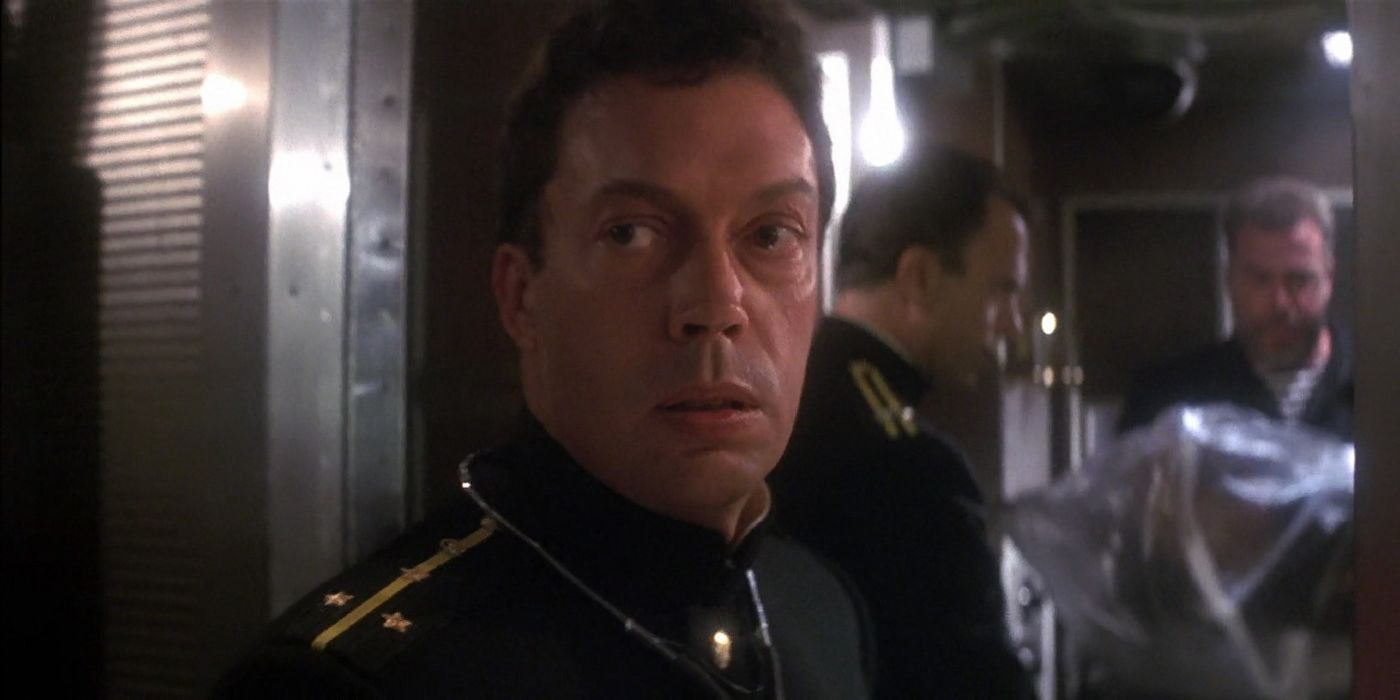
There’s a reason The Hunt for Red October keeps turning up whenever people start arguing about the best military thrillers ever made. It’s smart without being stiff, tense without overplaying its hand, and built around a concept that instantly works: A Soviet submarine captain may be defecting to the United States, but if the wrong people make the wrong assumption first, the whole thing could tip into catastrophe. That setup has powered the film for more than three decades, and now Paramount+ is adding it to its May 1 lineup.
Directed by John McTiernan and based on Tom Clancy’s novel, the film stars Sean Connery (Goldfinger, Indiana Jones and the Last Crusade) as Marko Ramius, Alec Baldwin (The Departed, Beetlejuice) as Jack Ryan, Scott Glenn (The Silence of the Lambs, Training Day) as Bart Mancuso, Sam Neill (Jurassic Park, Event Horizon) as Vasily Borodin, James Earl Jones (Field of Dreams, The Lion King) as Admiral Greer, Joss Ackland (Lethal Weapon 2, Bill & Ted’s Bogus Journey) as Andrei Lysenko, and Tim Curry (The Rocky Horror Picture Show, Clue) as Dr. Petrov.
The “Top Gun meets Crimson Tide” shorthand gets at the movie’s appeal pretty neatly: It has the muscular military-movie confidence of one and the chess-match submarine tension of the other. Even now, it still feels crisp, controlled, and ridiculously watchable.
Your answers have pointed to one Oscar Best Picture winner above all others. This is the film that was made for the way your mind works.
You are drawn to films that operate on multiple levels simultaneously — that begin in one genre and quietly, brilliantly migrate into another. Bong Joon-ho’s Parasite is a film about class, desire, and the architecture of inequality that manages to be darkly funny, deeply suspenseful, and genuinely shocking across a single extraordinary running time. Your instinct is for cinema that hides its true intentions until the moment it’s ready to reveal them. Parasite is exactly that — a film that rewards close attention and punishes assumptions, right up to its devastating final image.
You want it all — and this film gives you all of it. The Daniels’ Everything Everywhere All at Once is one of the most maximalist films ever made: action comedy, multiverse sci-fi, family drama, existential crisis, and a genuinely earned emotional core that sneaks up on you amid the chaos. You are someone who responds to ambition, who doesn’t want cinema to choose between being entertaining and being meaningful. This film refuses that choice entirely. It is overwhelming by design, and its overwhelming nature is precisely the point — because the feeling of being crushed by infinite possibility is exactly what it’s about.
You are drawn to cinema on a grand scale — films that understand history not as a backdrop but as a force, and that place their characters inside that force and watch what happens. Christopher Nolan’s Oppenheimer is a film about the terrifying gap between what we can do and what we should do, told with the full weight of one of the most consequential moments in human history behind it. You want your films to feel important without feeling self-important — to earn their ambition through sheer craft and the gravity of their subject. Oppenheimer does exactly that. It is enormous, complicated, and refuses easy comfort.
You are drawn to films that foreground their own construction — that make the how of the filmmaking part of the what it’s about. Alejandro González Iñárritu’s Birdman, shot to appear as a single continuous take, is cinema examining itself through the cracked mirror of a fading actor’s ego. You respond to formal daring, to the feeling that a film is doing something that probably shouldn’t be possible. Michael Keaton’s performance and Emmanuel Lubezki’s restless camera create something genuinely unlike anything else — a film that is simultaneously about creativity, relevance, self-destruction, and the impossibility of ever truly knowing if your work means anything at all.
You are drawn to cinema that trusts silence, that refuses to explain itself, and that treats dread as a form of meaning. The Coen Brothers’ No Country for Old Men is a film about the arrival of a new kind of evil — implacable, arbitrary, and utterly indifferent to the moral frameworks we use to make sense of the world. It is one of the most formally controlled films ever made, and its controlled restraint is what makes it so terrifying. You want your films to haunt you, not comfort you. You are not interested in resolution if resolution would be dishonest. No Country for Old Men is honest in a way that most cinema never dares to be.
The legendary Roger Ebert wrote that The Hunt for Red October works because it builds its suspense around intelligence rather than noise. The story follows Jack Ryan, the one man who believes Soviet captain Ramius is not preparing to attack America but is instead trying to defect with a powerful new submarine. That setup gives the movie its central tension, as Ryan has to convince everyone else that they are reading the situation all wrong. One of the film’s biggest strengths is how clearly it handles a complicated plot. There are a lot of moving parts, a lot of important characters, and a lot of military and political maneuvering, but the movie never becomes confusing. Instead, it turns all of that into part of the fun.
The Hunt for Red October arrives on Paramount+ next week.
](/tag/action/)
](/tag/adventure/)
](/tag/thriller/)
Donald E. Stewart, Larry Ferguson, Tom Clancy
In November 1984, the Soviet Union’s best submarine captain violates orders and heads for the U.S. in a new undetectable sub. The American CIA and military must quickly determine: Is he trying to defect or to start a war?