Taylor Gates is an Indiana native who earned her BFA in Creative Writing from the University of Evansville. She fell in love with entertainment by watching shows about chaotic families like Full House, The Nanny, Gilmore Girls, and The Fosters.
After college, she moved to Los Angeles to pursue a career as a writer, editor, and filmmaker. Today, she’s a sucker for dramedies — especially coming-of-age stories centering around complex female and LGBTQ+ characters. She has been with Collider since May 2022.
Popcorn, peanut M&M’s, and The Devil Wears Prada — those were the sleepover staples when I was in junior high. Sure, sometimes my friends and I subbed in 13 Going on 30 or Mean Girls for some variety, but we always found our way back to Runway Magazine. It was our absolute favorite, as evidenced by the fact that, one time, we watched it at night, and the next morning, turned it on again while eating our pancakes. We couldn’t get enough of the memorable soundtrack, stunning outfits, luxurious locations, and quippy lines that we quoted incessantly. Miranda’s classics, of course — ones about cerulean, florals, and moving at glacial paces — but also Emily’s deeper cuts about cubes of cheese, red-hot pokers, and loving her job.
Needless to say, I was highly anticipating The Devil Wears Prada 2, equally excited and nervous to see how they were going to continue a story that was so pivotal for me. I was expecting to laugh and have a fun time, and while I don’t think it’s quite as sharp or clever as the first film, I definitely did both of those things. I wasn’t expecting to tear up and feel so seen as an entertainment journalist, and yet that happened, too.
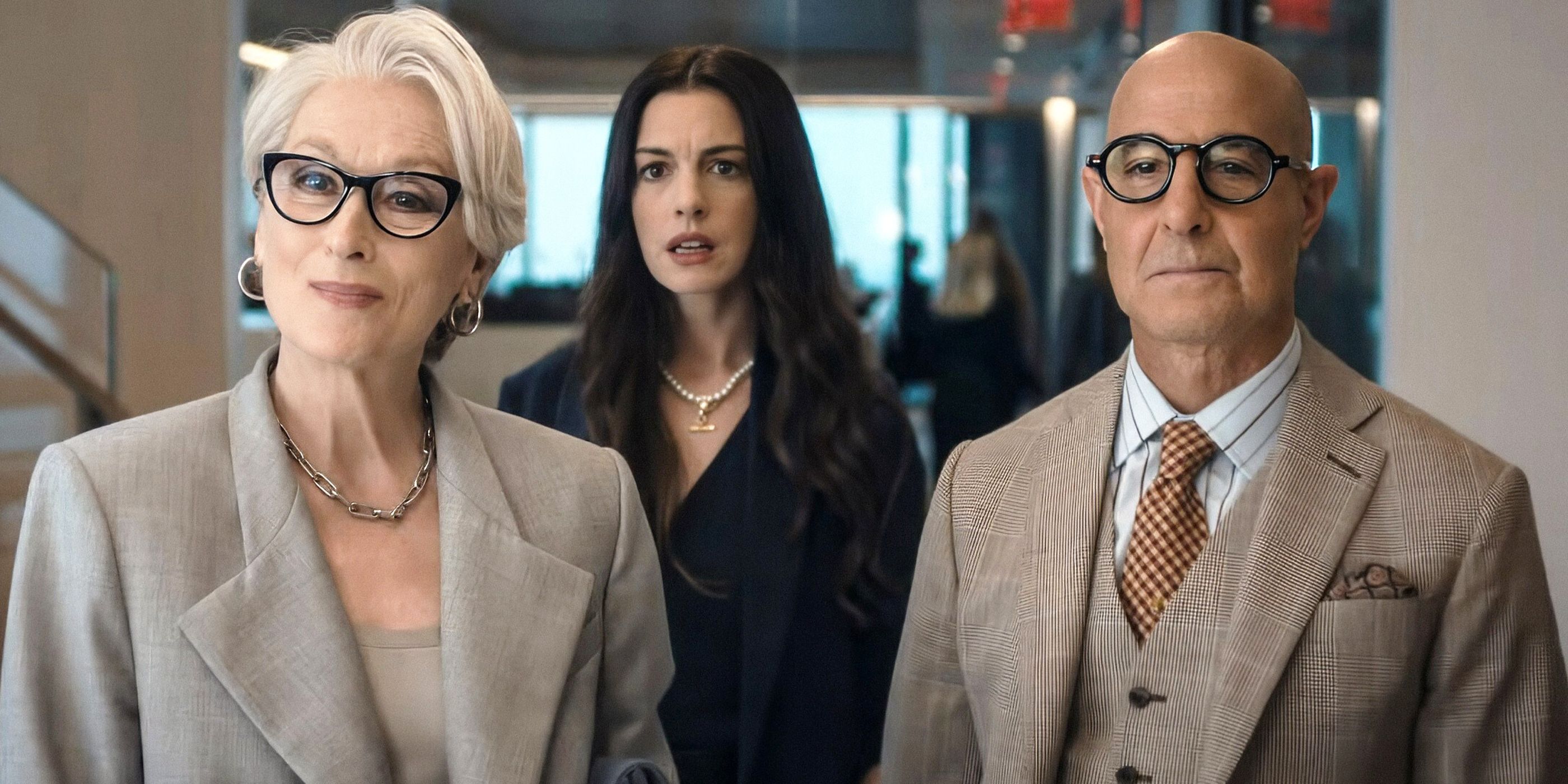
*The Devil Wears Prada 2 *smartly finds a way to get everyone back together quickly. After an opening montage that has delightful parallels to the first film’s, we discover that Andy (Anne Hathaway) is living her dreams as a “serious journalist.” Right before she wins a prestigious award for one of her pieces, however, she discovers that she — along with her whole team — has been laid off via text. She needs a new job, and fast.
Coincidentally, one becomes available at Runway after the magazine gets dragged for doing a glowing piece on what turns out to be a sketchy fast-fashion brand, putting Miranda’s (Meryl Streep) reputation — and big promotion — in jeopardy. Irv (Tibor Feldman), the head of Runway’s parent company, offers Andy a Features Editor position and tasks her with helping Miranda and Nigel (Stanley Tucci) clean up the mess. That includes patching things up with angry advertisers, including Dior, where Emily (Emily Blunt) has worked her way up to being a senior executive.
Your answers have pointed to one Oscar Best Picture winner above all others. This is the film that was made for the way your mind works.
You are drawn to films that operate on multiple levels simultaneously — that begin in one genre and quietly, brilliantly migrate into another. Bong Joon-ho’s Parasite is a film about class, desire, and the architecture of inequality that manages to be darkly funny, deeply suspenseful, and genuinely shocking across a single extraordinary running time. Your instinct is for cinema that hides its true intentions until the moment it’s ready to reveal them. Parasite is exactly that — a film that rewards close attention and punishes assumptions, right up to its devastating final image.
You want it all — and this film gives you all of it. The Daniels’ Everything Everywhere All at Once is one of the most maximalist films ever made: action comedy, multiverse sci-fi, family drama, existential crisis, and a genuinely earned emotional core that sneaks up on you amid the chaos. You are someone who responds to ambition, who doesn’t want cinema to choose between being entertaining and being meaningful. This film refuses that choice entirely. It is overwhelming by design, and its overwhelming nature is precisely the point — because the feeling of being crushed by infinite possibility is exactly what it’s about.
You are drawn to cinema on a grand scale — films that understand history not as a backdrop but as a force, and that place their characters inside that force and watch what happens. Christopher Nolan’s Oppenheimer is a film about the terrifying gap between what we can do and what we should do, told with the full weight of one of the most consequential moments in human history behind it. You want your films to feel important without feeling self-important — to earn their ambition through sheer craft and the gravity of their subject. Oppenheimer does exactly that. It is enormous, complicated, and refuses easy comfort.
You are drawn to films that foreground their own construction — that make the how of the filmmaking part of the what it’s about. Alejandro González Iñárritu’s Birdman, shot to appear as a single continuous take, is cinema examining itself through the cracked mirror of a fading actor’s ego. You respond to formal daring, to the feeling that a film is doing something that probably shouldn’t be possible. Michael Keaton’s performance and Emmanuel Lubezki’s restless camera create something genuinely unlike anything else — a film that is simultaneously about creativity, relevance, self-destruction, and the impossibility of ever truly knowing if your work means anything at all.
You are drawn to cinema that trusts silence, that refuses to explain itself, and that treats dread as a form of meaning. The Coen Brothers’ No Country for Old Men is a film about the arrival of a new kind of evil — implacable, arbitrary, and utterly indifferent to the moral frameworks we use to make sense of the world. It is one of the most formally controlled films ever made, and its controlled restraint is what makes it so terrifying. You want your films to haunt you, not comfort you. You are not interested in resolution if resolution would be dishonest. No Country for Old Men is honest in a way that most cinema never dares to be.
Things get more complicated as power struggles emerge between Irv’s son, Jay (B. J. Novak), and Emily’s new billionaire boyfriend, Benji (Justin Theroux). Everyone has a different vision for the future of Runway, but very few of them benefit the employees who actually work there and the legacy of the brand they’ve worked tirelessly to build. Fashion, journalism, and the zeitgeist as a whole are changing, for better and for worse, and everyone has to figure out how to work together and adapt, lest they be behind.
To the surprise of absolutely no one, Streep and Hathaway are as excellent as ever, seamlessly slipping back into their roles as if no time has passed and playing off of each other deliciously. Their characters are consistent with the ones we were introduced to two decades ago, but they aren’t completely frozen. Miranda and Andy’s core essences remain unchanged, but they — and their relationship — have progressed and evolved in a way that makes sense. It’s not an easy line to walk, but the two Oscar winners do it with ease.
Blunt was the breakout of the first movie, emerging as one of the funniest parts and holding her own just fine alongside a titan like Streep. Her comedy skills have only improved, once again stealing just about every scene she’s in. She earned both my biggest laughs and gasps over the two-hour runtime, full of savage surprises at every turn and a shocking amount of vulnerability beneath her vain, irritable exterior. I wish the film had delved more deeply into the specifics of what exactly went down between her and Miranda to land them in the positions we find them in, but we get just enough for it all to work.
Integrating new characters is often where sequels stumble, but The Devil Wears Prada 2 nails it when it comes to its fresh-faced Runway employees. Simone Ashley is undoubtedly the standout, taking the fabulous baton from Blunt as Miranda’s first assistant, the scrumtiously snarky Amari. She pays tribute to Blunt’s iconic performance while making the role her own. Caleb Hearon and** Helen J. Shen** take up Andy’s mantle in their own ways, with Hearon acting as Miranda’s overworked second assistant and Shen as Andy’s eager right-hand woman. They each bring a welcome energy, getting their moments to shine without overshadowing the OGs.
Journalism is currently in a tough place. The rise of AI usage and tech conglomerates downsizing and merging media companies has made it difficult to find and keep a job in the industry. Those who are lucky enough to be employed are facing pressure to get clicks and improve metrics to make advertisers and shareholders happy, even if that comes at the cost of covering stories that matter. The Devil Wears Prada 2 makes this a central part of its plot and handles it with an unexpected amount of nuance and care. While the first film felt like a love letter to fashion, this one feels like a love letter to journalists. (Though that’s not to say that The Devil Wears Prada 2 isn’t full of its fair share of fashion, too. While it trades Paris for Milan, the sense of glamor — and feast of cameos — remains.)
The Oscar-winning actor has had an incredible career so far.
The movie plays into the way culture has changed in the 20 years since the first film, without getting too cheesy or preachy in either direction, lightly poking fun at Boomers and Gen Z alike. While some characters and plots are obviously inspired by famous figures and events, like Elon Musk and the Bill Gates/Melinda French Gates divorce, it wisely decides not to make anything a shallow one-to-one parody.
For those still craving justice for Nigel two decades after Miranda’s betrayal, I’m pleased to inform you that you will be very happy with the way the film unfolds for him. The film justifies its existence purely for his arc and the full-circle nature of his journey. Tucci is the heart and soul of this film, even catching me off guard by eliciting some well-earned tears.
The only aspect that really doesn’t work is the romance. Something that made the first film so effective was the way that the audience saw Miranda almost entirely from Andy’s point of view. The sequel gives us more scenes of Miranda’s personal life with her husband, Stuart (Kenneth Branagh), which are not only not additive, but take away some of the mystique that makes Miranda such a compelling enigma. The lack of conflict or passion between Miranda and Stuart means their scenes don’t serve much of a purpose, not giving us much new insight into Miranda that we haven’t already inferred through her dynamics with other people. The more interesting choice could have been bringing her now adult twin daughters back, but they are nowhere to be seen.
Andy’s fling with a contractor named Peter (Patrick Brammall) is sweet and charming but lacking real heat or originality. It ends up feeling rather underbaked and forgettable, as if it were thrown in at the last minute. Their scenes are cute, but I found myself antsy to get back to the Runway of it all. The time the movie devotes to developing their relationship would have been better spent focusing on fleshing out more of the workplace happenings.
The chemistry between the returning and new characters of Runway in The Devil Wears Prada 2 is spot-on, making the film feel cohesive, and it successfully tackles crucial issues of our modern era that are relevant for 2026. While there may be one or two too many callbacks to the first film and a couple of unnecessary subplots, the sequel doesn’t rely entirely on nostalgia, nor does it strip away everything that made the original great. Maybe it’s not a perfect balance, but it’s pretty close to it. I don’t think I’ll be quoting this one as frequently as the first, but I certainly see myself grabbing some popcorn and peanut M&M’s for a pretty epic double-feature in the future.
The Devil Wears Prada 2 ](/tag/movie/the-devil-wears-prada-2/)
Aline Brosh McKenna, Lauren Weisberger