If you look at the** IMDb **page that lists sci-fi television shows from the 1990s, you’ll find over 50 titles, and that’s likely not even the entirety of it. The reason why the 1990s were so fruitful in terms of science fiction storytelling is the technological revolution and the awakening of CGI on the big (and small) screens. With better tech came bigger possibilities to make a believable, exceptional world of wonder that would immerse viewers.
Besides tech, the prevailing curiosity of otherworldly existence never seems to die down. Since the 1960s and the Space Race, we’ve been seeing various stories about what might exist out there, beyond Earth, and how humanity could be important in such a discovery. The 1990s was the greatest decade for sci-fi, and these shows prove it; they prove that people dared to dream bolder, bigger, and better than ever before, passing on that passion and curiosity to newer generations.
In the 1990s, science fiction was mostly serialized, but The Outer Limits showed that the anthology format was still as popular as ever, especially since The Twilight Zone never truly went out of fashion. The show wasn’t a brand-new concept when it was released in 1995; it’s a revival of the classic 1960s anthology of the same name that shifted away from the well-known “monster of the week” formula and toward the dangers of technology, making cautionary tales out of artificial intelligence and body horror. Episodes about mutations and aliens were genuinely haunting, inviting viewers to think beyond what they already know, thanks to a combination of practical effects and emerging CGI. With an IMDb rating of 7.7/10, it’s a must-see for any fan of cerebral sci-fi.
The Outer Limits is a seven-season anthology series with 152 episodes, each of which serves as a moral message or cautionary tale. Every episode is a standalone story about the dark consequences of scientific hubris, ranging from rogue AI and genetic mutations to alien invasions and government conspiracies. Guided by a foreboding narrator named Control Voice (Kevin Conway), the show told cautionary tales in which humanity frequently paid a high price for its curiosity. The pilot episode was based on a story by George R. R. Martin and Leonard Nimoy appears in one episode, which was directed by his son Adam. The Outer Limits may not be as great as its predecessor, but it’s definitely a grandly cynical vision of the future that only showrunners in the ’90s could have made.
Space: Above and Beyond was co-created by James Wong and Glen Morgan; Wong is the acclaimed director of the first Final Destination film, and he’s also co-written for The X-Files and*** American Horror Story***. His unique blend of sci-fi and horror worked well for Space: Above and Beyond, which was conceived as a sort of “World War II in space,” serving as a stark precursor to Battlestar Galactica’s gritty reboot, which relied heavily on a dark tone, political thrills, and realism. Unlike established polished utopias, Space: Above and Beyond depicts a desperate, confusing conflict fought by soldiers who were often outmatched.
Space: Above and Beyond takes place between 2063 and ‘64, following a futuristic humanity colonizing other planets. During an exploration mission, Earth’s forces come across an unknown alien race called the “Chigs,” sparking a tense interstellar war. The protagonists of the story are the “Wildcards,” a tough squadron of fighter pilots—including artificially created humanoid warriors called In Vitroes—as they face discrimination, religious doubt, and the brutal reality of combat in a war they never wanted to be a part of. Space: Above and Beyond was canceled after only one season, which ended on a shocking cliffhanger, but its 23 episodes had a significant impact on the genre, even gaining it Emmy nominations. Today, fans regard it as one of the best sci-fi war dramas ever made.
Dark Skies was arguably the most ambitious sci-fi series of the 1990s, and it’s a true conspiracy gem for fans of The X-Files and political espionage. For its ardent fans, the show’s story depth and seamless integration of 1960s history with UFO lore made Dark Skies a fantastic, deeply enjoyable, and complex experience. Though some criticized it at the time for being just a well-executed imitation of existing shows, its grim, tense atmosphere and refusal to rely on a week-by-week format have aged well, allowing it to stay relevant. Dark Skies was canceled after a single season of 18 episodes, but it remains a uniquely entertaining “what if” for history buffs and sci-fi fans alike.
Dark Skies depicts a vividly illustrated alternate history of 1960s America, in which a young couple discovers that the 1947 UFO crash in Roswell was only the beginning of a silent alien invasion. As they attempt to expose the truth, they are pursued by Majestic 12, a sinister secret government organization. The show weaves its sci-fi narrative through real-world events, from the Kennedy assassination to the Beatles’ American invasion, revealing the “hidden truth” behind the conspiracy; many actors play existing famous people, including Carl Sagan,** Marilyn Monroe**, and Colin Powell. Brent V. Friedman and Bryce Zabel, the show’s creators, created a story plan that spanned five seasons, but with indications that Dark Skies may be completely canceled during its run, the final episode of the first season provides a somewhat fitting conclusion.
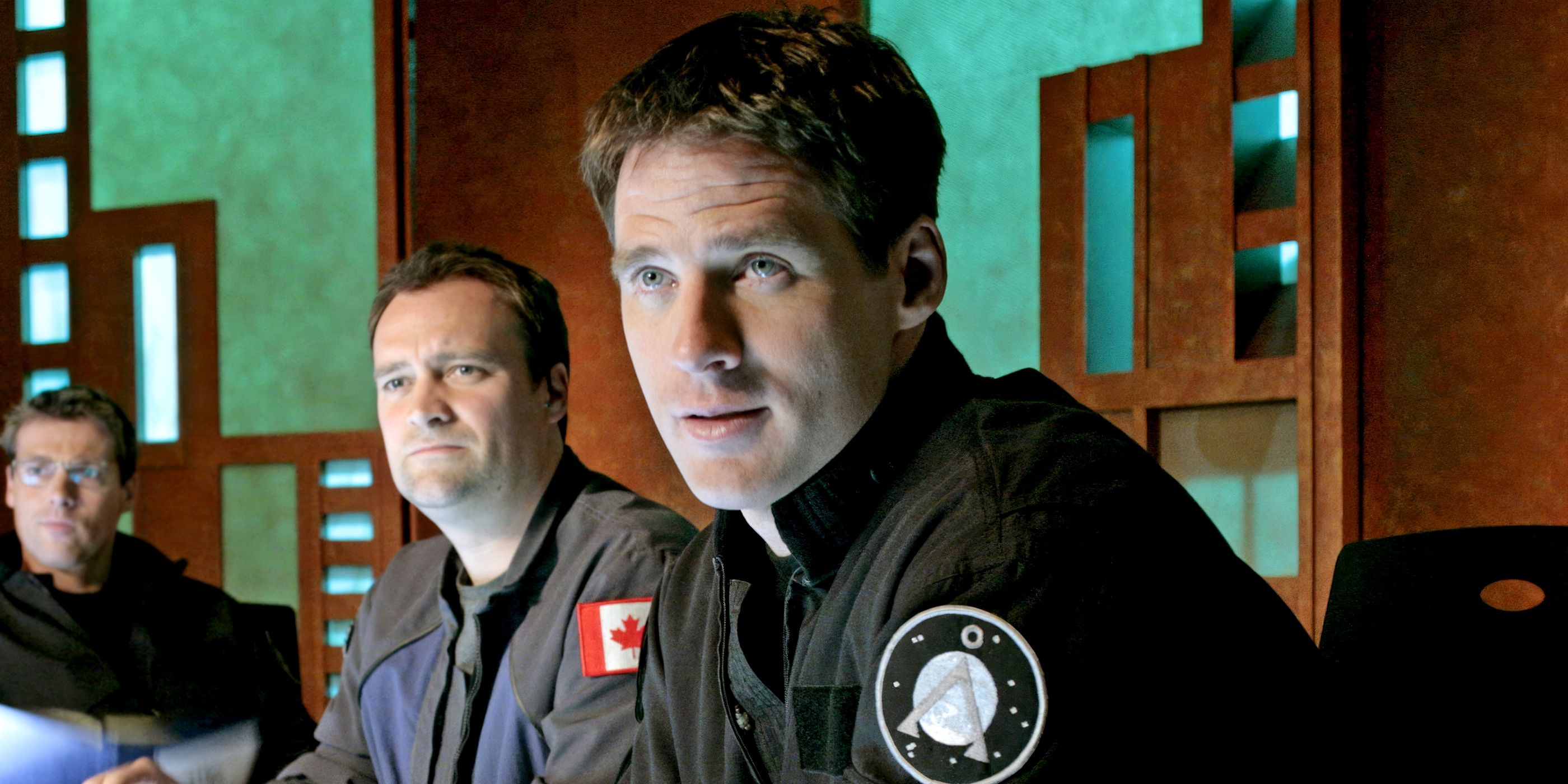
Considering that Stargate, the film, was not the shining example of great sci-fi blockbusters of the 1990s, the series that spawned from it, Stargate SG-1, did an excellent job of keeping the lore alive. For over a decade, it was the dependable workhorse of sci-fi television, providing an ideal blend of military realism and otherworldly exploration. It lasted 10 seasons and filled a void for fans who craved the sense of wonder and unknown that many genre shows had previously provided. In its early run, Stargate SG-1 was heavily character-driven and horror-focused, but its solid plot, intricate visual effects and production design, and great character arcs helped it build a massive, enduring fan base. It became a true genre staple, with a devoted cult following that fueled three live-action spin-off series and one animation.
Stargate SG-1 is set one year after the events of the 1994 film, implying that the Stargate program has been discontinued. However, when Colonel Jack O’Neill (Richard Dean Anderson) discovers that the volatile alien race known as Goa’uld is preparing a massive attack, the secret facility is reactivated. O’Neill leads a military-science expedition team known as SG-1 to explore the galaxy using the ancient network of portals. Their mission is to bring advanced technology back home to protect the planet, but each step into the unknown brings them closer to either dying in the attempt to save Earth or discovering something they can’t come back from. Throughout its 10-season run, Stargate SG-1 received 129 nominations and won 22 of them, including four Saturn Awards for Best Syndicated Television Series. Fans of the ***Mass Effect ***games might particularly enjoy Stargate SG-1.
Your answers point to the world your instincts were built for. This is the universe your temperament, your survival instincts, and your particular brand of stubbornness were made for.
You took the red pill a long time ago — probably before anyone offered it to you. You’re a systems thinker who can’t help but notice the seams in things.
The wasteland doesn’t reward the clever or the well-connected — it rewards those who are hard to kill and harder to break. That’s you.
You’d survive here because you know how to exist in moral grey areas without losing yourself completely.
Arrakis is the most hostile environment in the known universe — and you are precisely the kind of person it rewards.
The galaxy far, far away is vast, loud, and in a constant state of violent political upheaval — and you wouldn’t have it any other way.
Aside from the big, famous, more muscular shows, there’s a cult classic in hiding: Farscape. Farscape is the epitome of a curated 90s sci-fi series; created in collaboration with The Jim Henson Company, the show was intricately strange, embracing chaos and camp to create something entirely unique. The aliens, despite being gimmicky and some being just humans in prosthetics, had greatly developed character arcs; some species were brought to life using advanced puppetry and animatronics capable of great emotional expression. Farscape was described as both a psychedelic action-adventure epic and a romantic character drama, with hallucinatory episodes and witty pop-culture moments that broke the mold of traditional space adventure. With a devoted fanbase, it remains a unique achievement in visual storytelling.
Farscape follows American astronaut John Crichton (Ben Browder) as he tests an experimental spacecraft when a wormhole violently catapults him across the universe, landing him in the midst of a prison break. Stranded on Moya, a mysterious, biomechanical living ship, he escapes with a group of equally desperate alien fugitives. Crichton, now pursued by the authoritarian Peacekeepers, must navigate a strange and dangerous galaxy using only his wits and a growing ability to tap into the wormhole knowledge inside his own head. The alien puppets were so complex that they required multiple operators, and the most iconic is Pilot, a creature permanently bonded to Moya, serving as her driver and voice.
Deep Space Nine, long dismissed as the dark Trek that stayed in one place, is now widely regarded as the most ambitious and well-written*** Star Trek* series. It was the **first Trek series to embrace serialized storytelling, long-form arcs, and moral ambiguity **while tackling more serious issues such as terrorism, genocide, religious faith, PTSD, and the ethics of war. The show’s final 10-episode arc (The Dominion War) is a masterpiece of television drama, culminating in a series finale that many fans regard as the best in Star Trek history. With an 8.1 IMDb rating and a resurgence of critical acclaim in the streaming era, *DS9 *has finally established itself as the pinnacle of 1990s science fiction.
DS9 is set on a decaying Cardassian space station named Deep Space Nine that orbits the strategic planet Bajor. The station’s commander, Benjamin Sisko (Avery Brooks), is tasked with assisting the Bajoran people in recovering from a brutal occupation, but his mission changes when a stable wormhole to the Gamma Quadrant is discovered, making Deep Space Nine the most important port in the galaxy. As the station becomes a hub for alien traders, religious pilgrims, and spies, **Sisko and his crew are caught up in a brewing conflict with the Dominion, a terrifying new power **from beyond the wormhole. The show’s creators had planned a more serialized format but were forced to keep it episodic at first. However, they won the battle over time, and by season four, DS9 had become the first Star Trek series to feature multi-episode arcs, paving the way for all modern serialized science fiction.
***Babylon 5 ***is the show that permanently changed the rules of television. Long before the era of prestige TV, creator **J. Michael Straczynski **meticulously planned a five-year “novel for television,” where every action had a consequence and characters grew and changed over time, with events in the show impacting each of them in different ways. The series explored themes of authoritarianism, faith, and sacrifice, and its use of low-cost Amiga computer graphics demonstrated that compelling narratives could outperform large budgets. The long-running Shadow War, depicted on a truly cosmic scale, produced some of the most ambitious and satisfying storylines of the 1990s.
*Babylon 5 *begins the year 2258, ten years after a devastating war with the Minbari. Earth has launched **Babylon 5, a five-mile-long space station designed to serve as a neutral diplomatic hub **between the galaxy’s major powers. Commander Jeffrey Sinclair (later Captain John Sheridan) is tasked with keeping the fragile alien alliance together. When the station’s commander is falsely accused of attempting to assassinate a mysterious Vorlon ambassador, he uncovers a sinister plot to plunge the galaxy back into all-out war. Michael O’Hare, who played commanding officer Sinclair, left after the first season and was replaced by **Bruce Boxleitner **as a completely different character, honoring O’Hare’s influence on Babylon 5’s humble beginnings. Many consider this show to be the greatest sci-fi series ever made.
*The X-Files *is what we call “the shot heard ‘round the world” for modern genre TV. It’s a show that achieved a rare trifecta of high ratings, critical acclaim, and a devoted fan base in a short period of time. Its cinematic visual quality paved the way for today’s high-budget prestige genre television, while the electrifying dynamic between the dependable cynic and the paranoid believer established a template for a generation of duos. Although it followed a terrifying and formulaic “monster of the week” format, The X-Files’ overarching mythology about several key events and characters made it both addictive and lovable.
The X-Files follows two FBI agents, Fox Mulder (David Duchovny) and Dana Scully (Gillian Anderson), who are assigned to the “X-Files,” a department that investigates unsolved paranormal cases. Mulder is a true believer, haunted by the disappearance of his sister as a child, whom he believes was abducted by extraterrestrials; Scully is a medical doctor and skeptic tasked with debunking Mulder’s claims and applying scientific analysis to the bizarre. Together, they discover a complex government conspiracy that threatens to reveal the truth about an alien invasion. Despite the show’s many iconic visual and narrative symbols, the iconic poster with a hovering UFO and the tagline “I Want to Believe” is likely its most well-known remnant. Originally taken in Europe, the production team used the photo without copyright clearance and had to change it in later seasons due to a lawsuit. The X-Files is one of the shows you can watch anytime, as it doesn’t seem to age; it only gets better with time.
](/tag/the-x-files/)
Science Fiction
](/tag/science-fiction/)
1993 - 2018-00-00
Rob Bowman, David Nutter, R. W. Goodwin, Michael W. Watkins, Tony Wharmby, Daniel Sackheim, Michael Lange, Cliff Bole, David Duchovny, Jim Charleston, James Wong, Peter Markle, Rod Hardy, Thomas J. Wright, William A. Graham, Jerrold Freedman, Joe Napolitano, Kevin Hooks, Larry Shaw, Richard Compton, Tucker Gates, Allen Coulter, Barry K. Thomas, Brett Dowler