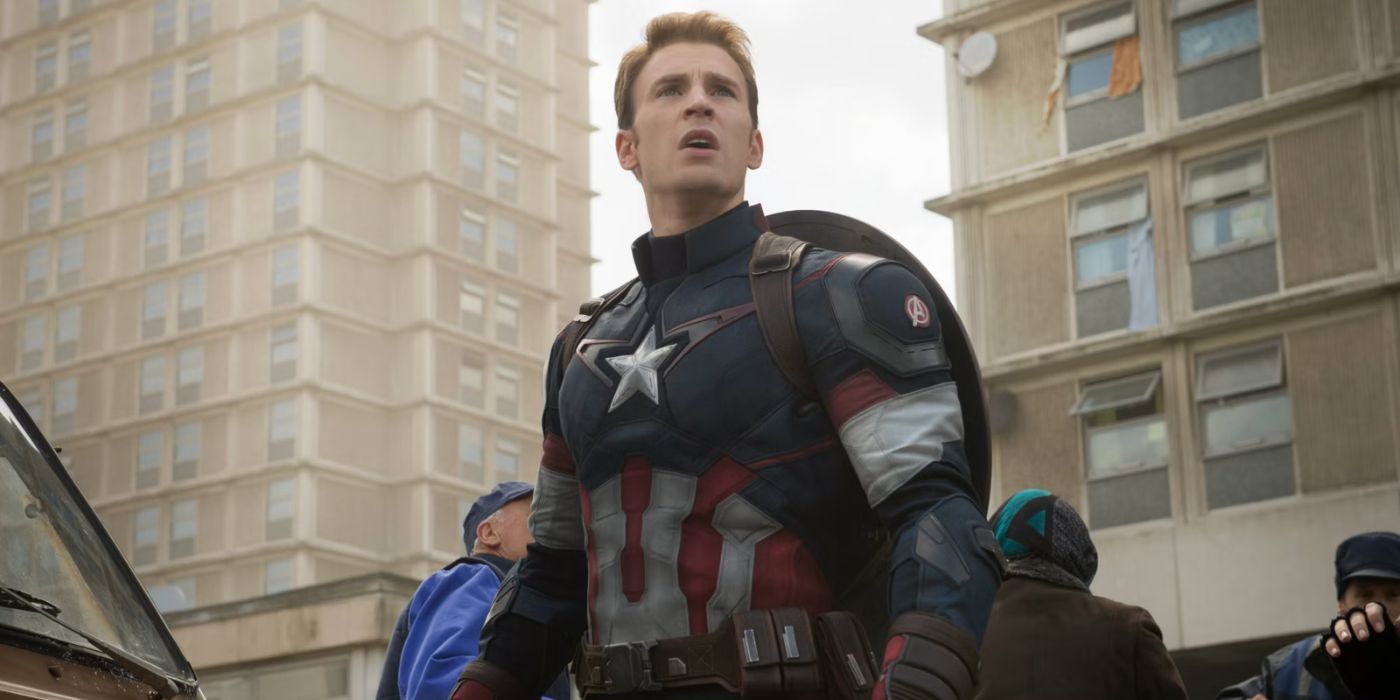
While Avengers: Age of Ultron probably isn’t people’s favorite MCU movie, (even though, I, for one, think it’s underrated), Chris Evans’ Captain America is certainly many people’s favorite superhero, and for good reason. He represents the best in humanity, never forgetting Dr. Erskine’s (Stanley Tucci) warning in Captain America: The First Avenger, to not forget about being a “good man,” when he’s trying to be a “perfect soldier.” Many also resonated with Cap’s anti-government sentiment, which really began in Captain America: The Winter Soldier and then came to fruition in Captain America: Civil War.
Age of Ultron largely skipped over this aspect of the character, however, instead focusing on the personal divide between Cap and Tony Stark (Robert Downey Jr.). And yet, one deleted scene from Avengers: Age of Ultron not only showed exactly why Steve Rogers connected with so many, but also would have shown the beginning of the end for the Avengers, as well as continuing this arc of the character becoming more nomadic. Not only should the scene have been kept in to show this character beat, but it would’ve begun the conversation around Cap’s costume, which we would later see thoroughly explored in later MCU projects. And though we’ll get to see how Rogers’ story continues in Avengers: Doomsday when Evans returns for his long-awaited return to the MCU, it’s worth noting that one of the most significant moments came in a divisive Marvel movie.
The deleted scene in question is one that occurs at the beginning of the third act. The scene shows Cap and some other Avengers, including the Scarlet Witch (Elizabeth Olsen) and Hawkeye (Jeremy Renner), getting out of the Quinjet in Sokovia before battling Ultron (James Spader). Cap sees graffiti artwork that depicts him as a “fasista” (fascist) as he goes to put his helmet on. Upon acknowledging how the Sokovian people feel about the Avengers, a western force entering their country to conduct operations without sanction, rather than wearing the accessory, Steve throws it back in to the jet, allowing people to see his face and therefore connecting with the people of Sokovia more.
While it is understandable why such a scene would be removed for runtime, with Age of Ultron already having a 2-hour 21-minute length, this scene should have been kept because it shows the growing divide in the Avengers that would continue into Captain America: Civil War. Throughout Age of Ultron, we see how Iron Man and Cap disagree, with Iron Man being a “big picture” thinker, whereas Cap is far more grounded, and this scene would have shown Cap’s side quite well, as most of Age of Ultron dealt with Iron Man’s paranoia.
Based on your answers, the Marvel hero who matches your spirit, values, and instincts has been revealed.
You carry the weight of the world on shoulders that are younger than they should have to be — funny, loyal, and endlessly self-sacrificing.
You fight in the shadows between law and chaos, guided by a fierce moral compass that refuses to let the guilty walk free.
Brilliant, driven, and occasionally insufferable — but always the person who solves the unsolvable problem.
You’ve been through fire that would break most people — and it did change you, completely. What’s left is unyielding, relentless, and operating by a code forged in grief.
Powerful, proud, and on a lifelong journey to become worthy of the legend you carry.
You believe in something bigger than yourself — and you fight for it even when the world has moved on and nobody else will.
This isn’t the first time Captain America’s costume has been a contentious issue. In ***The ***Avengers, it is Phil Coulson (Clark Gregg) who says people need the classic “old-fashioned” Captain America costume and see it as something familiar to give them hope, before the world changed with the reveal of Loki (Tom Hiddleston) and the more fantastical elements. Therefore, with Cap throwing away this helmet, we’re seeing him doubt the message that the Stars and Stripes and the idea of a soldier fighting for America are good ways to be a superhero for the world, a refreshingly self-aware representation of how many in the world view not just the West, but America itself. This idea is also discussed in Falcon & The Winter Soldier, where Sam Wilson (Anthony Mackie) points out the inner conflict he faces as a Black man wearing an American flag.
All of this is to say that this deleted scene should have been kept because it is part of the story of Captain America and his costume, and the costume truly does mean so much to the audience and character. Wearing a uniform or flag matters, and we cannot pretend it doesn’t. In this deleted scene, we see Cap beginning, more than ever, to outright reject his Western-centric image, and it would have been a nice clue as to the way the series was going to start turning. Some could argue that Captain America: The Winter Soldier did show this, yet that doesn’t mean *Age of Ultron *should’ve ignored it the way it did, as it focused on a more personal conflict rather than internal one on Cap’s side.
Avengers: Age of Ultron ](/tag/avengers-age-of-ultron/)
](/tag/action/)
](/tag/adventure/)
Science Fiction
](/tag/science-fiction/)
](/tag/superhero/)