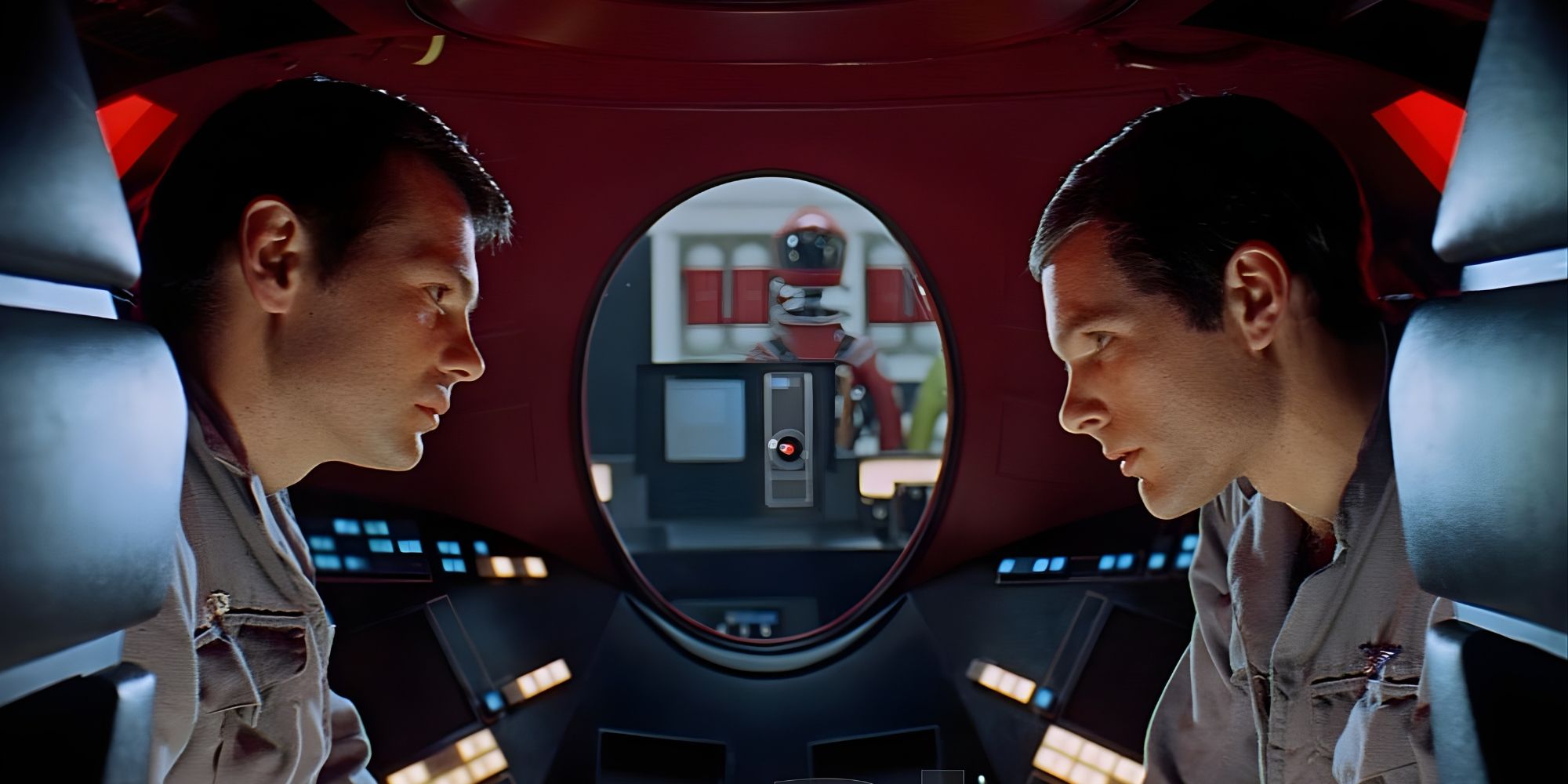
Hard science fiction is a unique subgenre that was originally coined by science fiction author and critic P. Schulyer Miller in 1957 and imagines extraordinary futures while remaining grounded in real scientific principles and the known laws of physics. Unlike space adventures and time-travel thrillers, hard sci-fi films such as Gattaca, Children of Men, and Interstellar, strive for authenticity and often combine rigorous scientific detail with deeply human and thought-provoking stories that linger with audiences long after the screen goes black.
Even though every hard science fiction movie is rooted in some sense of realism, there are a handful of titles, including Alfonso Cuarón’s Gravity, Ex Machina, and Her starring Joaquin Phoenix, Amy Adams, and Scarlett Johansson, that are superior to other entries in the subgenre when it comes to logic and accuracy. From the 1997 science fiction drama Contact starring Jodie Foster and Matthew McConaughey to Stanley Kubrick’s groundbreaking sci-fi classic, 2001: A Space Odyssey, these are ten of the most realistic hard science fiction movies to date, ranked!
Robert Zemeckis’ Contact is an intriguing hard science fiction film starring Jodie Foster as a SETI scientist, Dr. Ellie Arroway, who manages to find evidence of life beyond Earth and is chosen to make first contact. Based on Carl Sagan’s 1985 novel, *Contact *ranks as one of the most realistic hard sci-fi movies because it treats extraterrestrial contact not as a fantasy or a spectacle, but as a scientifically grounded and philosophically serious possibility.
The movie’s realism comes from its attention to scientific detail and its refusal to rely on impossible technology or exaggerated action. Concepts such as signal decoding, engineering challenges, and the social impact of first contact with non-human life are presented to audiences in an incredibly convincing manner. Instead of focusing on battles or invasions, Contact explores deeper questions about the universe and humanity’s desire for meaning while also effectively portraying how scientific discoveries are often shaped by politics, pressure, and skepticism.
Ex Machina* ***is a spellbinding hard sci-fi flick that centers around a programmer, Caleb Smith (Domhnall Gleeson), who is invited by the CEO of his company (Oscar Isaac) to stay for a week at his lavish estate to test a highly intelligent humanoid named Ava (Alicia Vikander). What makes Ex-Machina especially realistic is its focus on the psychological and ethical dimensions of artificial intelligence, which suggests that truly advanced AI might not overpower humans physically, but it could potentially outsmart them by understanding their emotions and desires better than humans understand themselves.
Ex Machina earned immense praise for its special effects, fascinating screenplay, and outstanding performances, notably by Vikander, who received a Golden Globe Award nomination for Best Actress. The movie earned two Academy Award nominations, including Best Original Screenplay, and went on to win the Oscar for Best Visual Effects. By grounding its ideas and premise in current AI theories, human behavior, and ethical questions, Ex Machina stands out as one of the most believable and intellectually realistic examples of hard science fiction cinema.
Gattaca is a must-see science fiction film that is set in a dystopian society driven by eugenics and follows Vincent Freeman (Ethan Hawke), whose natural genetic makeup prevents him from achieving his dream of traveling through space. In an effort to alter his fate, Freeman assumes the identity of laboratory-engineer genes and joins the Gattaca space program, but his plan becomes compromised when a Gattaca officer is found dead on board. The movie also stars Uma Thurman, Jude Law, and Gore Vidal.
One of the film’s greatest strengths is its focus on human and ethical consequences, which raise important questions about free will, identity, and whether human potential can genuinely be measured by biology alone. Even though eugenics has been largely discredited, Gattaca still reflects concerns already present in modern society and expands on technologies that already exist, such as gene analysis and the growing ability to predict health risks through DNA, making it **one of the most realistic and thought-provoking examples of hard science fiction cinema. **
*Gravity *is one of the latest examples of near-perfect hard science fiction that centers around the real-life concept of a cascading chain of satellite collisions known as the Kessler Syndrome. The movie stars Sandra Bullock and George Clooney as astronauts who try to return to Earth after their space shuttle is damaged while in orbit. The key to the film’s success the extensive research conducted by director Alfonso Cuarón and his team, which provides the movie with recognizable real-world technology and an accurate depiction of space shuttles, suits, and emergency protocols, giving Gravity a definitive sense of visual realism.
While Cuarón admitted that some liberties were taken for dramatic purposes, many astronauts, including Buzz Aldrin and Garrett Reisman, and physicists consider Gravity one of the closest mainstream films to have captured what being stranded in orbit accurately could feel like, physically and emotionally. Gravity earned ten Academy Award nominations, including Best Picture, Best Production Design, and Best Actress for Bullock, and ended up winning seven of its nominations, notably for Best Director, Best Cinematography, and Best Visual Effects.
Based on the 1992 novel written by **P.D. ****James, Children of Men is one of the greatest dystopian movies that stands out for its depiction of a future that feels like a believable extension of present-day society rather than a world built on fantasy and speculation. Clive Owen stars as a disillusioned government official, Theo Faron, who lives in a world where women have been infertile for decades, causing mass hysteria and chaos. When Faron tries to help a young refugee (Clare-Hope Ashitey) escape to safety, he learns that she is potentially the key to saving the entire human race.
Children of Men remains focused on its story of survival, morality, and hope instead of technological wonder and advancements, and essentially examines humanity under pressure. The movie received critical acclaim and received three Academy Award nominations for Best Adapted Screenplay, Best Cinematography, and Best Editing. Although the infertility premise itself is unexplained and speculative, the social consequences in Children of Men are portrayed with unusual realism, which is why many critics and scholars consider it to be one of the most convincing and intellectually hard science fiction films ever made.
Amy Adams stars in Denis Villeneuve’s Arrival as a linguistics professor, Louise Banks, who, along with an elite team of investigators, rushes to find a way to communicate with extraterrestrial life after several gigantic spaceships touch down around the world.* Arrival* is based on the 1998 novella, Story of Your Life, written by Ted Chiang, and moves away from the elements of a traditional action-packed alien invader flick and draws from real ideas in Linguistics, specifically the controversial Sapir–Whorf hypothesis, which is the theory that language can influence perception and thought.
The movie does take speculative liberties, especially regarding how language could alter perception of time, but it builds those ideas carefully from existing linguistic and physical theories rather than fantasy logic. Arrival was a major success and received several Academy Award nominations, including Best Picture, Best Director, and Best Adapted Screenplay, winning one of its nominations for Best Sound Editing. Overall, the film’s combination of intellect, scientific method, and human behavior is essentially why Arrival is frequently praised as one of the most realistic and sophisticated modern science fiction films.
Spike Jonze’s Her, is an unusual love story starring Joaquin Phoenix as a lonely writer, Theodore Twobly, who, while in the middle of a depressing divorce, tries to find comfort in an artificially intelligent operating system known as Samantha (Scarlett Johansson), leading him to develop an unusual friendship with her that grows into an unexpected romance. Considering the recent advancements in AI in current society, especially with operating systems that are designed to be digital companions, **the premise of Her is entirely plausible, making it one of the most realistic hard sci-fi movies in modern cinema. **
Her was a critical and commercial success that earned several Oscar nominations and went on to win for Best Original Screenplay for Jonze. Instead of focusing on machines taking over the world or exterminating the human race, Her explores relatable themes such as loneliness, intimacy, emotional dependency, and how technology can change relationships between both people and the real world. The movie is speculative, specifically regarding the depth of consciousness AI could potentially achieve, but it avoids depicting a digital fantasy and treats it as a social and psychological development rather than an action premise.
The Martian is an Oscar-nominated sci-fi adventure directed by Ridley Scott and is based on Andy Weir’s 2011 novel, which tells the harrowing story of a group of astronauts who, during a mission to Mars, are forced to take off during a dust storm and accidentally leave behind one of their own, Mark Watney (Matt Damon). As Watney tries to survive on the desert planet with little resources, NASA scientists work tirelessly around the clock to try to bring him home while his crew decide to secretly hatch their own plan for a dangerous rescue mission.
The premise of The Martian is essentially an engineering problem of how to keep someone alive on a lifeless planet like Mars using limited supplies, chemistry, botany, and physics. Most of the obstacles that Damon’s character faces, like growing food and producing water, are solved through realistic scientific reasoning, even if dramatized. One of the movie’s standout qualities is its depiction of the habitat on Mars and its use of crucial elements such as rovers, spacesuits, orbital transfers, and life-support systems are heavily inspired by actual NASA concepts for future exploration of Mars.
Christopher Nolan’s Academy Award-winning sci-fi masterpiece Interstellar is one of the most realistic hard sci-fi movies in recent years that builds its story around real theoretical physics and space exploration concepts while trying to remain scientifically grounded wherever possible. The movie is set in a dystopian future where Earth is suffering from famine and blight and follows a group of astronauts and scientists as they travel through space in search of a new home for humanity. The movie features an ensemble cast of stars including Matthew McConaughey, Anne Hathaway, Michael Caine, and Casey Affleck.
Nolan worked closely with theoretical physicist Kip Thorne, a leading expert on black holes and relativity, who established two rules for the film: avoid violating the established laws of physics and all speculation must be backed by science. One of the film’s most famous ideas is extreme gravitational time dilation near a massive black hole, which is a concept Thorne based directly on Albert Einstein’s theory of relativity. Even though the movie dramatizes this effect, the underlying physics of it are entirely accurate. While the movie becomes a bit speculative towards the end, many physicists still regard Interstellar as one of the most scientifically ambitious science fiction films ever made because so much of its foundation rests on authentic astrophysics and relativity theory.
Stanley Kubrick dazzled audiences with his Oscar-nominated sci-fi classic, 2001: A Space Odyssey, which earned universal praise for its accurate portrayal of space travel and artifical intelligence. The movie is based on several short stories written by famed sci-fi writer, Arthur C. Clarke, who co-wrote the screenplay with Kubrick, and follows an astronaut (Keir Dullea) who is sent on a mysterious mission into space with the ship’s computer system, HAL, acting as his guide, but when HAL starts exhibiting strange behavior, the mission turns into an intense showdown between man and machine.
While the movie isn’t entirely “hard science” in the strictest sense, Kubrick and Clarke did work closely with aerospace experts to ensure accuracy of the film’s technology and various environments, which is essentially why 2001: A Space Odyssey is often regarded as one of the greatest foundational hard science fiction films ever made. The mysterious monoliths and the final “Star Gate” sequence move into symbolic and speculative territory that goes beyond known science, even by today’s standards, but the film’s spacecraft, AI, and operational realism were undeniably decades ahead of their time.
Your answers point to the iconic sci-fi hero who shares your instincts, your values, and your particular way of facing the impossible.
You carry a weight most people would crumble under — the knowledge of what you’re capable of, and the burden of what you might have to become.
You lead with instinct, warmth, and an absolute refusal to accept a no-win scenario — because you’ve always believed there’s a third option nobody else has thought of yet.
You are the kind of person who holds the line when everyone else is losing faith — not because you’re fearless, but because giving up simply isn’t something you’re capable of.
You are not reckless, not grandiose, and not particularly interested in being anyone’s hero — you just refuse to stop when it matters.
You have been through fire that would break most people — and what came out the other side is something the world underestimates at its peril.
2001: A Space Odyssey ](/tag/2001-a-space-odyssey/)
Science Fiction
](/tag/science-fiction/)
](/tag/adventure/)