Published Jul 4, 2026, 8:00 PM EDT
Nicolas Ayala is a Senior Writer for the Comics team at ScreenRant, with over five years of experience writing about Superhero media, action movies, and TV shows.
Sign in to your ScreenRant account
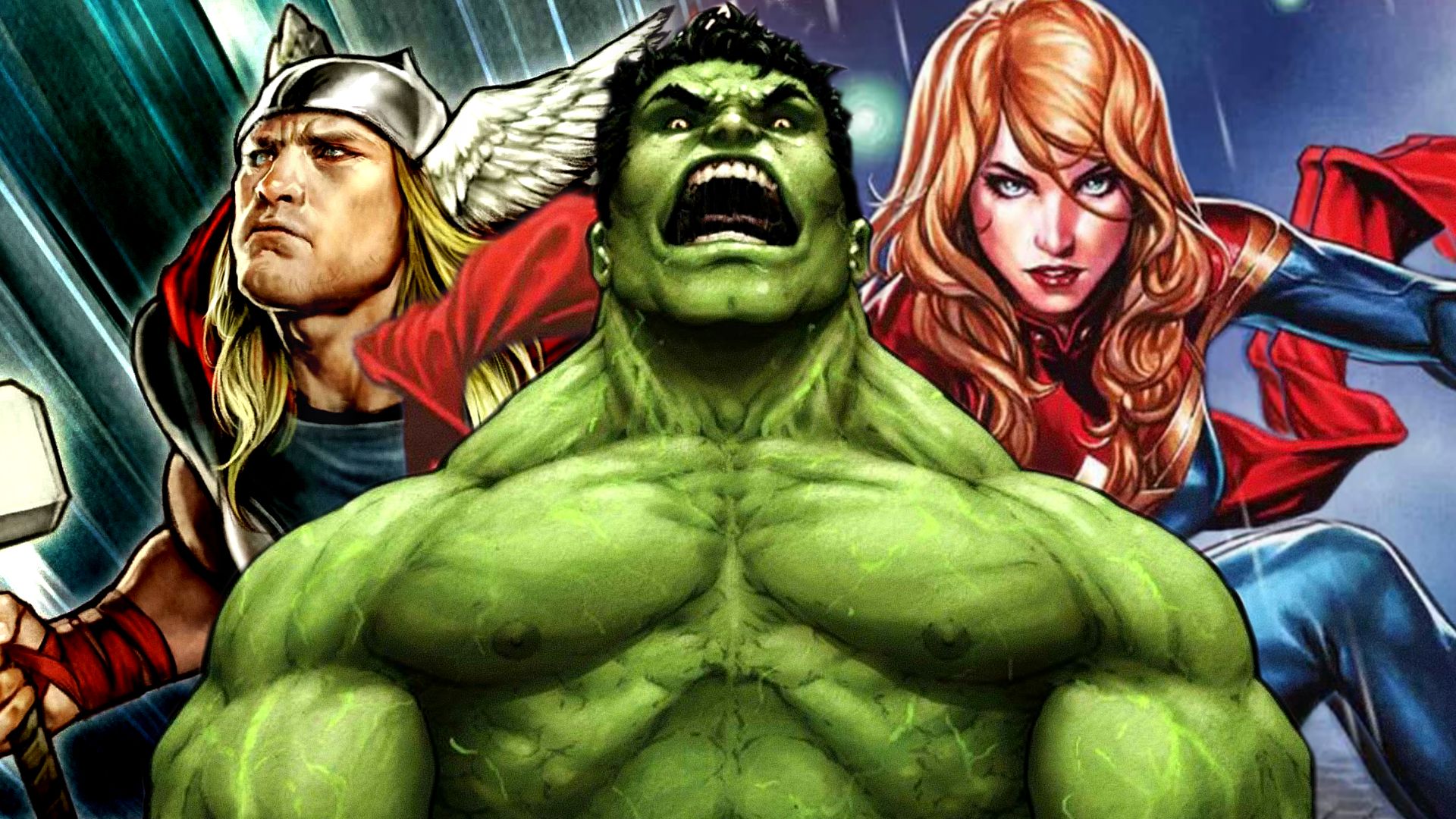
A select few Avengers can pride themselves on being physically stronger than the Hulk, with a few caveats. At his baseline levels, particularly when calm or only mildly agitated, Hulk can be challenged by characters who are nowhere near the top of Marvel’s power levels. Throughout the years, characters like Captain America and Wolverine have occasionally managed to stun the Hulk with strategic combat and well-landed blows. However, as Hulk’s anger increases, so too does his strength and durability, often to seemingly limitless degrees. Much more powerful characters need to intervene in these situations.
Avengers such as Captain Marvel, Rogue, Wonder Man, She-Hulk, Red Hulk, and the Thing have all demonstrated the ability to fight the Hulk on relatively equal footing, at least temporarily, thanks to their own immense physical power and stamina. Captain Marvel and Rogue both have the same amount of strength, and their flight abilities allow them to attack Hulk from different angles. Likewise, Wonder Man’s ionic strength and flight make him inexhaustible in battle. Both She-Hulk and Red Hulk would be able to contain a base-level Hulk, and the Thing has built an entire legacy around battling the Green Goliath.
These Marvel powerhouses may be able to equal the Hulk’s strength, survive his attacks, or even defeat him under specific circumstances, but the biggest threat lies in the Hulk’s limitless reserves of energy. In cases where Hulk grows indefinitely stronger, it’s up to the top tier of Marvel heroes to deal with the raging Jade Giant.
Hercules is one of the most straightforward Marvel powerhouses, as his main power is an immense amount of physical strength, which he famously demonstrates during his mythical Twelve Labors. Long after killing the Nemean Lion and the Hydra, Hercules consistently matches the Hulk’s strength. Unlike Thor, Hercules lacks significant ranged attacks or magical abilities, which forces the Olympian god to engage the Hulk on his own terms. Luckily, Hercules’ greatest advantage is his extraordinary combat experience, especially with monstrous creatures like the Hulk.
This distinction is particularly apparent in arcs such as World War Hulk, where Hercules initially fights the Hulk with tremendous effectiveness, but ultimately discovers the limitations of his divine strength when confronted by the Green Scar, who surpasses the regular limits of Savage Hulk’s rage even without the need to lose control. The Hulk’s ever-increasing power transforms a regular contest of strength into a contest of endurance, and few characters in Marvel lore have demonstrated the capacity to outlast an enraged Hulk. Although it’s only a matter of time until Hulk exceeds a god’s might, Hercules’ divine strength is a reliable obstacle to the rampaging gamma mutate.
Thor has historically been the hero most consistently portrayed as the the Hulk’s equal, largely because Thor usually happens to be present when the Green Goliath loses control. Thor combines his naturally immense Asgardian power with magical weaponry, weather manipulation, energy projection, and thousands of years of combat experience. Multiple battles across Journey into Mystery, The Avengers, and The Incredible Hulk have established a recurring pattern. Thor can match the Hulk physically for extended periods with the help of Mjolnir and the power of the storms, but he has learned that containing or outmaneuvering Bruce Banner’s alter ego is a much more effective strategy.
Nevertheless, Thor’s track record against the Hulk illustrates the same dilemma faced by every other Marvel titan. Thor has scored numerous victories and stalemates throughout the decades, and he’s more than capable of knocking out a baseline Savage Hulk, either with or without Mjolnir. However, in events like World War Hulk and* Fear Itself*, Thor’s innate Asgardian strength is less relevant as the Hulk approaches his upper levels of strength. Once Hulk has grown angry enough, Thor needs to resort to strategies other than mere punches.
One of Marvel’s many parallels to DC’s Superman, Hyperion is officially an Avenger despite the fact that he rarely joins Earth’s Mightiest Heroes in their world-saving battles. Every once in a while, Hyperion crosses paths with the Avengers and their enemies, and sometimes, it’s his turn to stop the Green Goliath. Hyperion possesses multiple avenues through which he can challenge the Hulk. His atomic vision, flight, and superhuman speed allow him to engage the Hulk from distances and angles unavailable to purely physical combatants, while his regular strength can easily knock the Hulk out.
Hyperion can defeat the Hulk under the right circumstances, particularly if he ends the conflict quickly or exploits his superior versatility. In The Avengers Vol. 5, Hyperion manages to fight a possessed Hulk to a standstill and distract him long enough for Thor to sever Abyss’ control, all while holding back his full power. Meanwhile, in 2021’s Heroes Reborn, Hyperion kills the Hulk every time he regenerates, successfully disintegrating the gamma monster dozens of times. In order to defeat an unrestrained Hyperion, Hulk would have to tap into the depths of his most destructive World-Breaker energy early on.
Blue Marvel combines his absurd physical strength with one of the greatest scientific minds in the Marvel Universe. Adam Brashear’s anti-matter physiology grants him strength and durability on a level that allows him to contend with nearly any terrestrial powerhouse, while his intellect enables him to approach combat in unique ways. Hence, Adam can knock the Hulk cold with a single punch, and he can devise highly effective combat strategies if Hulk’s anger and strength increases. If that weren’t enough, Blue Marvel’s energy manipulation abilities provide options unavailable to most other heroes.
The main reason why Blue Marvel isn’t considered an automatic response to the Hulk’s rampages is that Adam Brashear has been relegated to the background of the Marvel Universe. The only instance where Blue Marvel has had the chance to fight the Hulk directly takes place in the original Ultimate Universe, Earth-1610, where Adam Brashear neutralizes Hulk by delivering a single punch to the monster’s jaw, leaving him unresponsive. Something similar would likely happen on Earth-1610 if the two were to meet, though the result also depends on which Hulk Adam ends up meeting.
Sentry may be the only major Marvel hero whose upper limits are portrayed as being as ambiguous as the Hulk’s. After all, Robert Reynolds suffers the same problem as the Hulk, possessing the power of millions of exploding suns, yet not being able to control it without awakening dark impulses and endangering everyone around him. Sentry’s most famous confrontation with the Hulk takes place in World War Hulk, where their massive power output leads them to cancel each other out and revert to their regular human selves.
Both Hulk and Sentry are beings of potentially limitless power constrained by deeply damaged human psyches. Sentry’s effectiveness fluctuates according to his mental state. This creates a remarkable inversion of the Hulk’s own psychology. Bruce Banner becomes stronger as his emotions intensify, while Robert Reynolds grows more volatile. If Sentry uses the power required to defeat or kill the Hulk effortlessly, Robert Reynolds has to pay the price for it, and the Void is bound to take the Hulk’s place as a danger to the world.
Which Avenger do you think is stronger than Hulk?
Who Can Really Stand Up To The Hulk?
Found an error? Send it info@screenrant.com so it can be corrected.
Robert Bruce Banner
First Appearance
The Incredible Hulk (1962)
Avengers, Defenders, Horsemen of Apocalypse, Fantastic Four, Pantheon, Warbound, S.M.A.S.H., Secret Avengers